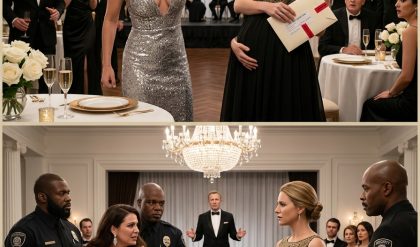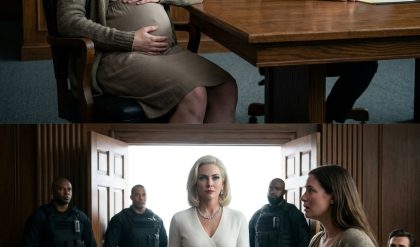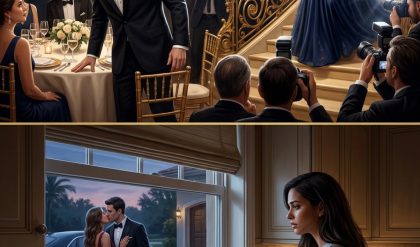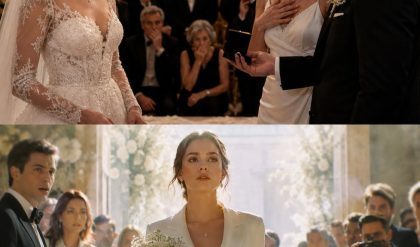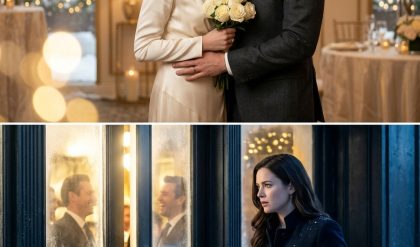
The heavy crystal chandelier above the ballroom seemed to hum with the collective tension of three hundred guesTS. No one moved.
The waiters stood frozen near the buffet tables, trays balanced awkwardly, while videographers zoomed in on the bead of sweat tracing a slow path down Madeline’s powdered temple.
Owen Whitmore pushed his chair back and stood up.
At six-foot-two, with broad shoulders and a sharp, analytical gaze that had earned him a reputation as one of the city’s most ruthless corporate litigators, he cut an imposing figure.
He didn’t look angry anymore; he looked clinical, much like the surgeons I worked alongside every day.
“Madeline,” Owen’s voice cut through the silence like a scalpel.
It wasn’t raised, but it carried the weight of absolute authority.
“What did she mean about my startup?”
Madeline’s face went from ghostly pale to a mottled, furious crimson.
Her veil, pinned precariously to her elaborate updo, shifted as she whipped her head around.
“Owen, don’t listen to her! She’s hallucinating! She’s always tried to sabotage everything good in my life—she couldn’t stand that I found a man who actually loves me, so she’s making up bankruptcy stories, embezzlement, fake documents—it’s all a sick game!”
“Is it a game, Madeline?” I asked quietly, keeping my hands clasped loosely in front of me, adopting the calm, measured posture I used when breaking terminal news to a family.
I didn’t need to shout.
The microphones wired into our dresses transmitted every syllable to the soundboard.
I turned to face the crowd, letting my gaze sweep over the rows of stunned faces—colleagues of Owen’s father, society acquaintances, and distant relatives who had spent the last hour whispering about my supposed cruelty.
“For five months,” I began, my voice echoing off the vaulted ceiling, “while Madeline was supposedly sacrificing her youth and career to wipe our father’s brow, she was actually clearing out his retirement accounTS. She told him it was a bridging loan for Owen’s tech venture, a venture that, according to public filings, went belly-up eighteen months ago—six months before Dad even had his stroke.”
Owen’s breath hitched.
He turned his sharp gaze back to his bride.
“My startup closed its Series A funding round through venture capital, Madeline.
I never asked your father for a dime.
In fact, I specifically told you we wouldn’t take family money.”
Madeline stumbled backward, her white satin train catching on the decorative staging lighTS. “He wanted to give it! He insisted! He loves us!”
“Dad loved us both,” I corrected, the memory of our father’s kind, tired eyes flashing through my mind.
“He also had early-stage vascular dementia diagnosed a year before the stroke—something Madeline conveniently forgot to mention when she had him sign a durable power of attorney at her kitchen table while I was on a twenty-four-hour hospital rotation.”
Margaret Whitmore stepped closer to me, her hand resting firmly on my forearm.
The physical gesture was a public endorsement that shattered whatever social armor Madeline had left.
“Go on, Dr. Bennett,” Margaret prompted gently, her eyes flashing with a fierce, protective intelligence.
“What else did she hide?”
“The house,” I said.
“Our childhood home—the one paid off by our mother before she passed away.
Two weeks after Dad’s stroke, Madeline had a quitclaim deed drawn up, transferring the property title into her sole ownership for the sum of ten dollars.
Dad’s signature looks like it was traced by a child with Parkinson’s.”
A collective gasp rippled through the room.
Several guests at the front tables pulled out their phones not to record, but to frantically search public property records, a task made easy by modern county databases.
“You’re lying! You’re a cold-hearted b****!” Madeline shrieked, the thin veneer of her bridal grace shattering completely.
She lunged forward, claws out, aiming for my face.
She didn’t get within three feet.
 The Queen’s Ledger
Owen stepped between us, his arm shooting out to block her path.
His expression was cold, devoid of any warmth or affection.
He looked at Madeline not as a blushing bride, but as an alien specimen under a microscope.
“Stop it, Madeline,” Owen commanded, his voice dropping an octave.
“Don’t touch her.”
“Owen! You’re taking her side? After everything we planned? After everything I sacrificed for you?” She burst into hysterical, choking tears, her mascara running in dark streaks down her cheeks.
It was a pathetic sight—a masterclass in emotional manipulation collapsing under the dead weight of verifiable facTS.
“You didn’t sacrifice anything for me, Madeline,” Owen said coldly, pulling a slim leather cardholder from his inner jacket pocket and sliding a gold band off his ring finger.
He tossed the ring onto the white tablecloth with a sharp clink.
“You used my name as a shield for financial fraud.
And you used your own sister—a woman who literally saves lives for a living—as a scapegoat to cover your tracks.”
“No! No, we can talk about this! In private! Please!” Madeline dropped to her knees on the polished wood stage, clutching at the hem of Owen’s tailored trousers.
The white silk pooled around her like a shroud.
Owen didn’t look down at her.
He stepped away, smoothing his jacket, and turned his attention back to me and Margaret.
“Dr. Bennett,” Owen said, dipping his head in a gesture of profound respect.
“I cannot apologize enough for what my family—or what I was about to make my family—has put you through tonight.
If there is anything I can do to assist your legal counsel in recovering your father’s assets, my firm’s resources are entirely at your disposal.”
“Thank you, Owen,” I replied evenly.
“You won’t need to look far.
The documents, along with the bank audit trails and the medical proxy revocations, are currently sitting on the desk of Detective Inspector Vance at the metropolitan fraud division.
I filed the paperwork this morning before I came here.”
Madeline let out a sound like a punctured lung—a long, agonizing wheeze of absolute defeat.
She slumped forward onto the stage floor, her elaborate veil catching on a loose nail, tearing free and fluttering down like a broken wing.
The silence in the ballroom was absolute, save for the hum of the air conditioning and the soft clicking of a single camera shutter from the back of the room.
Margaret smiled, a warm, genuine expression that reached her eyes.
“Well,” she murmured, linking her arm through mine.
“That certainly beats cutting the cake.
Shall we leave these children to their mess and find a glass of champagne that isn’t steeped in perjury?”
I looked out at the three hundred guests, many of whom were now quietly gathering their coats and whispering among themselves, realizing they had front-row seats to a criminal investigation disguised as a wedding reception.
I looked back at my sister, broken and weeping among her ruined silk and shattered fantasies.
For thirty-eight years, I had carried the invisible weight of being the “family failure” in her warped narrative—the cold, unfeeling careerist who abandoned her duties.
But as I walked down the stage stairs beside the woman whose beating heart I had personally held in my hands, I realized something liberating.
Some wounds can’t be healed with a bandage or a polite smile.
Sometimes, you have to cut deep, expose the rot to the light, and let the infection bleed out entirely before true healing can begin.
“I’d love a glass of champagne, Margaret,” I said, and for the first time in months, I smiled.
The surgery was complete.
And the patient was finally free.